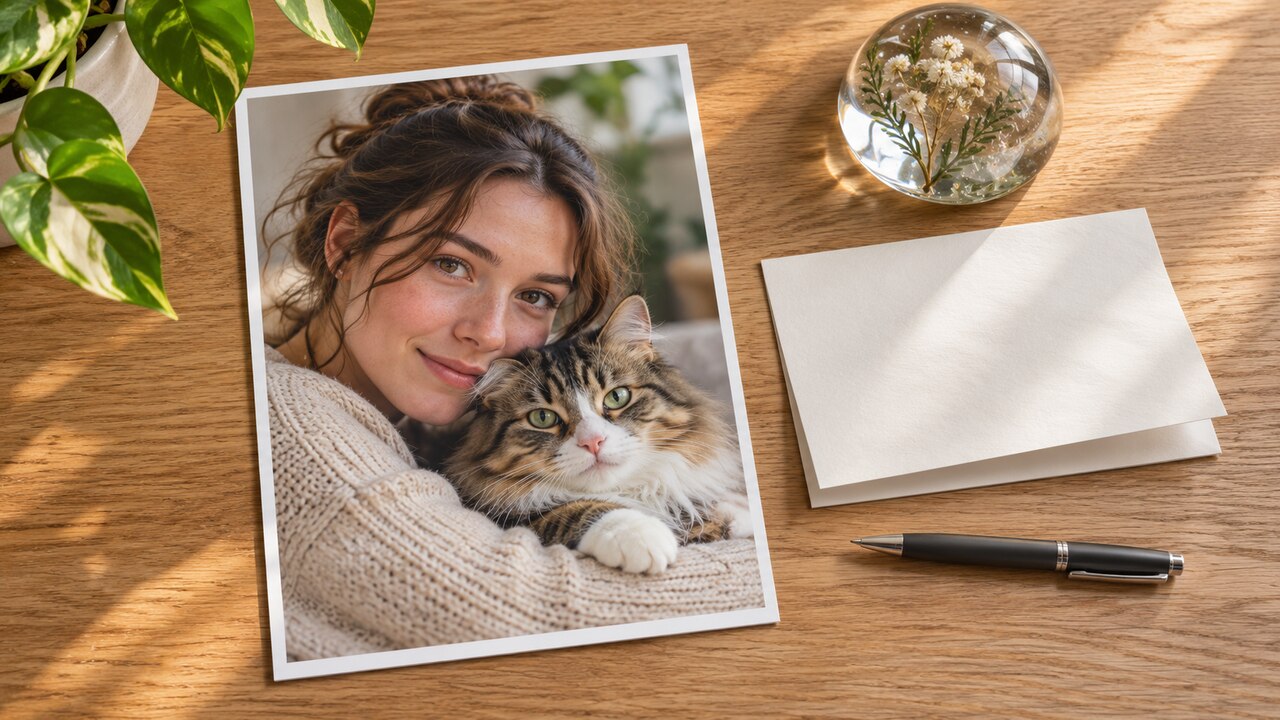
You made a portrait of you and your dog, and it's good — good enough to print, to put on a card, maybe to sell on a mug. What are you actually allowed to do with it? The honest answer has three layers, two of which are simple and one of which is genuinely unsettled. Here's the short guide, in plain language (which is not legal advice).
Layer one: your photos, your pet — simple
The photos you upload — of yourself, of your pet — are your images, and your pet's likeness is yours to use. Uploading them to generate portraits doesn't change their ownership. In the normal flow, the inputs are unambiguous.
Layer two: personal use — also simple
Sharing your portrait, posting it, printing it, framing it, making cards and gifts for family: nobody's legal system is interested in stopping you, and it's what the tool is for. A seasonal card run of the owner-and-pet portrait you made is the product working as intended.
Layer three: generated images and copyright — the unsettled part
Whether an AI-generated image can be owned under copyright law — and by whom — is genuinely evolving, and jurisdictions disagree. The consistent themes across current positions:
- Purely machine-generated output may not qualify for copyright protection at all in some jurisdictions, because copyright historically rewards human authorship. In the US, the Copyright Office's position has been that works lacking human creative control aren't registrable — though human contribution (your photos, your prompts, your selection and editing) can change that analysis.
- What that means practically: for personal use, nothing. For commercial use, the gap matters — an image that carries no copyright can't stop others from copying it, which is worth knowing before you build a product line on one.
- Platform terms matter. What the service you generated with grants you — usage rights, commercial terms, what happens to your inputs — is the contract you actually operate under. Ours are in the terms; if you're generating elsewhere, read theirs.
The two-minute checklist before commercial use
- Check the platform's terms for commercial-use grants on generated images.
- Keep your input photos and final images organized — provenance is your record of the human contribution.
- If a recognizable person beyond you appears (a friend, a celebrity lookalike prompt), get their consent. Personality and likeness rights are separate from copyright and much less unsettled.
- If a brand, logo, or another artist's style-as-identity is involved, pause — trademark and unfair-competition rules apply regardless of how the image was made.
Frequently asked questions
Can I sell things printed with my AI pet portrait?
Generally yes under our terms, with the practical caveat above: an AI-generated image may not carry copyright you can enforce against copycats. For a small craft line that's usually acceptable risk; for a brand you intend to defend, it's worth specific advice.
Does adding my photos make the result "mine"?
Your photos remain yours, and your creative direction matters in several jurisdictions' analyses of the output — but "mine" in the full copyright sense is exactly the part that's still being worked out case by case.
Can someone else use my portrait once I post it?
Platform rules and ordinary copyright norms apply as with any posted image; the wrinkle is that if the image itself carries no copyright, your enforcement options may be thinner than with a photograph. Watermarking or keeping publishes deliberate are the pragmatic protections.